The slotting problem spreadsheets miss
Most slotting decisions are made with ABC analysis: rank SKUs by velocity, put A-movers close to the pick station, B-movers in the middle, C-movers at the back. It is correct in principle and wrong in practice — because it ignores the dynamic interactions that determine real pick performance.
What actually determines throughput: the mix of orders arriving in each wave, the interference between pickers in the same aisle, the lift equipment required for upper levels, the AGVs and AMRs competing for aisle access, and the impact of replenishment traffic running against pick traffic. These interactions change the effective travel distance for any given slotting strategy far more than the static ABC zone assignment does.
The core problem: Slotting is an optimisation problem under uncertainty and dynamic load. A static ABC analysis gives you the right answer for average demand. Simulation gives you the right answer for your actual order profile — including peaks, wave patterns, and mixed picker types.
Three dimensions simulation addresses
Slotting strategy
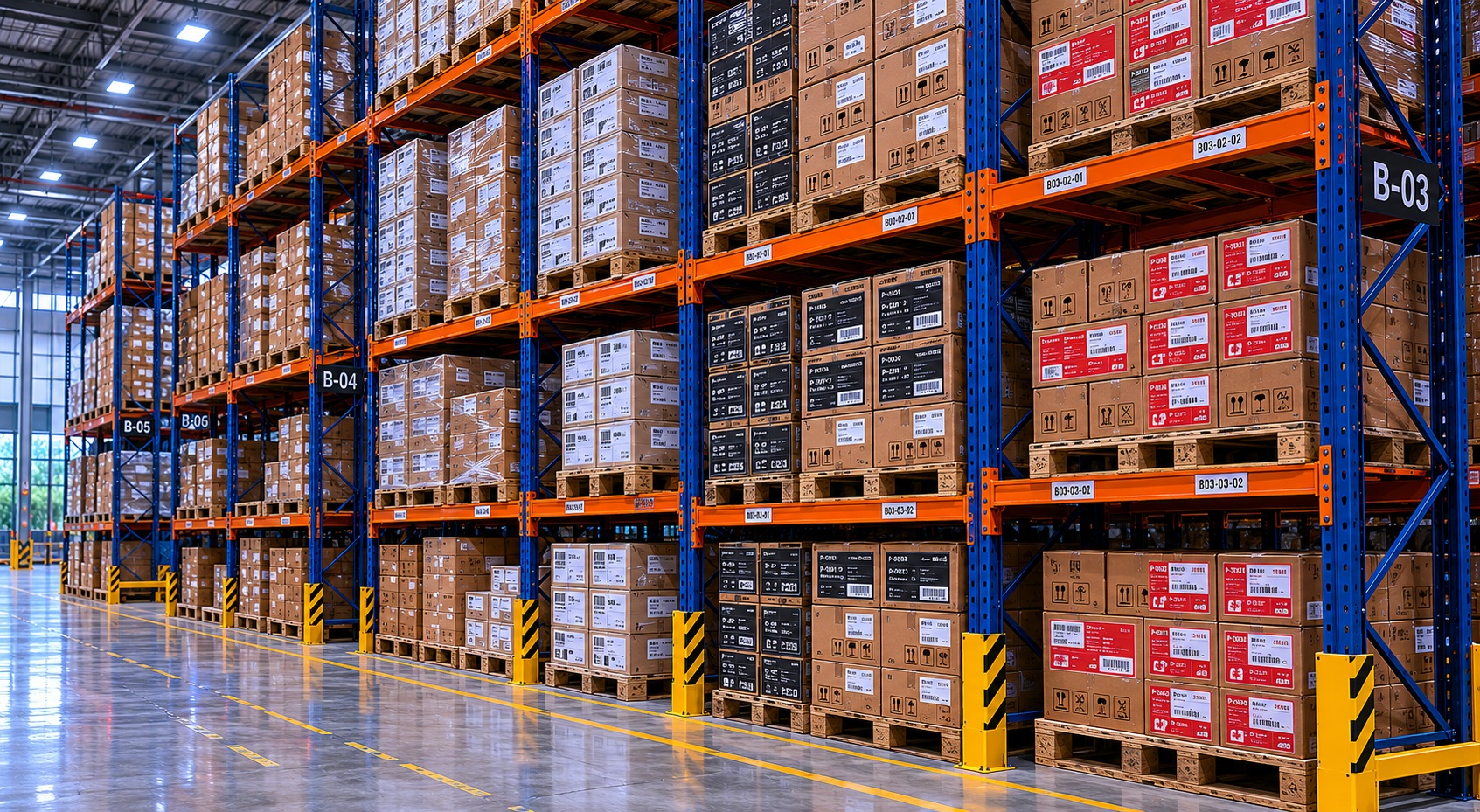
Where each SKU lives — zone assignment, height level, and bay position. Simulation tests ABC, velocity-based, order-based clustering, and family grouping strategies against your actual order history and future demand projections, including seasonal shifts.
Aisle configuration
How wide aisles need to be, where cross-aisles are placed, how pick stations and staging areas are positioned. These layout decisions interact with slotting strategy — a narrow-aisle setup requires different slotting than a wide-aisle layout with counterbalance forklifts.
Picker & equipment mix
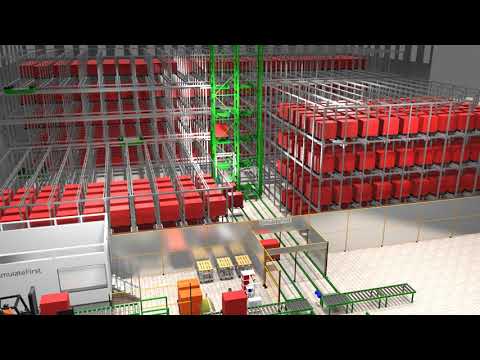
Human pickers, AGVs, AMRs, and automated storage systems share the same aisles. A slotting strategy that works for human pickers may create conflict zones for AGV routes. Simulation places all agents in the layout simultaneously and identifies interference before it becomes a physical problem.
When simulation beats slotting software
Off-the-shelf slotting tools — Slotwise, Manhattan, BlueYonder — handle single-picker, single-aisle environments well. They calculate optimal placement based on velocity and ergonomics. Simulation becomes the right tool when the decision is more complex:
| Scenario | Slotting software | Simulation |
|---|---|---|
| Single picker type, simple order profile | Suitable | Overkill |
| Mixed pickers: human + AGV or AMR | Limited | Handles fully |
| Multi-level racking with lift equipment | Approximates | Models lift cycles, contention |
| Batch & wave picking patterns | Averages | Captures peak-wave interference |
| Layout is still a variable | Requires fixed layout | Tests multiple layouts in parallel |
| Replenishment traffic interaction | Not modelled | Modelled as concurrent process |
| Seasonal demand shifts require re-slotting | Manual re-run | Automated scenario matrix |
Our process
SKU velocity & order profile analysis
We analyse your SKU data by velocity, order co-occurrence, and demand variability. This establishes the slotting baseline and identifies which SKUs drive most of the picker travel — typically 15–20% of SKUs account for 70–80% of picks. We also map your order wave patterns, batch sizes, and peak demand profiles.
Layout & equipment model
The Simio model is built from your CAD layout or floor plan: aisles, racking bays, height levels, pick stations, staging areas, and charging zones. All picker and equipment types are added — human pickers with realistic walk speeds, AGVs with their fixed routes, AMRs with dynamic navigation, and any automated systems such as conveyors or sorters.
Slotting scenario matrix
We test the slotting strategies you want to compare — typically 20+ configurations — including your current slotting as a baseline. Each scenario runs under your real order profile with statistical replications to account for demand variability. Outputs include picker travel distance, aisle congestion frequency, throughput per shift, and equipment utilisation by zone.
Recommendation & implementation guide
You receive a ranked comparison of slotting strategies with travel distance and throughput curves, a specific slotting recommendation for your SKU set, an aisle congestion heatmap, and an implementation sequencing guide — which SKUs to move first if you are re-slotting a live warehouse. The Simio model is handed over for future reruns.
What you get at the end
What data do we need?
A focused slotting study can start with order history alone. A combined layout + slotting study needs:
- Order history — 6–12 months of order lines with SKU, quantity, and timestamp (CSV or WMS export)
- SKU master data — dimensions, weight, and current location for each active SKU
- Floor plan or CAD layout — with aisle widths, racking bay positions, and height levels
- Equipment specifications — picker types, AGV/AMR specs if applicable, lift equipment turn radii
- Shift patterns — shift start/end, pickers per shift, wave scheduling if used
- Throughput targets — lines per hour, orders per shift, or pallets per day
Don't have all of this? Order history and a floor plan are enough to start. SKU master data can be approximated from carton standards, and picker profiles can be calibrated from industry benchmarks. We will tell you exactly what we need — and what we can work around — in the scoping call.
Tools & technology
Slotting and layout studies use Simio for the discrete-event simulation layer — picker agent behaviour, equipment routing, and aisle traffic. For large SKU catalogues where the slotting itself is a combinatorial optimisation problem, we layer in Python with a clustering and assignment optimiser before feeding the result into the simulation for validation. For facilities with AGV or AMR fleets, we connect slotting scenarios directly to our fleet model.
For clients looking for shift-level decision support — dock assignment, replenishment sequencing, task interleaving — we also build operational planning tools on request. These run simulation scenarios in minutes so operations managers can compare options at the start of each shift. Ask about bespoke tooling if this matches your need.
See it in practice
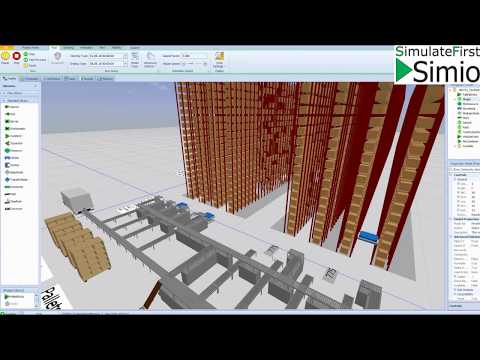
ASRS new build — row/level configuration & loading strategy optimisation
Simio · Logistics
Scalable e-commerce warehouse — AGV & ASRS sizing
Simio · Logistics