The problem with estimating AGV fleet size
When planning a new warehouse or upgrading an existing one, the question of how many automated guided vehicles (AGVs) you need is critical — and almost always answered wrong the first time.
Rule-of-thumb calculations, vendor proposals, and spreadsheet models all miss the same thing: the interactions between vehicles. A single AGV blocked at a charging station, or two vehicles contending for the same aisle, can cascade into throughput failures that no static calculation can predict.
The result is over-buying to be safe — paying for vehicles you don't need — or under-specifying and discovering the bottleneck only after go-live, when the cost of fixing it is ten times higher.
The fundamental issue: AGV fleet performance is non-linear. Adding a 10th vehicle to a fleet of 9 doesn't add 10% capacity — it may add 3%, or reduce throughput if the aisle becomes congested. Only simulation captures this.
How simulation answers the question
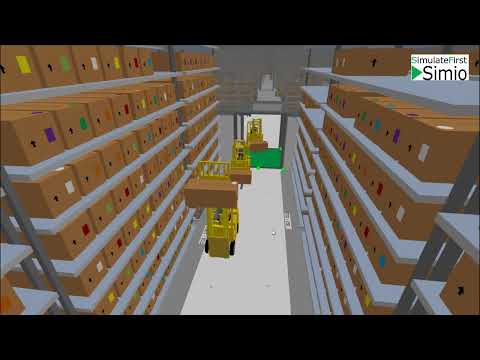
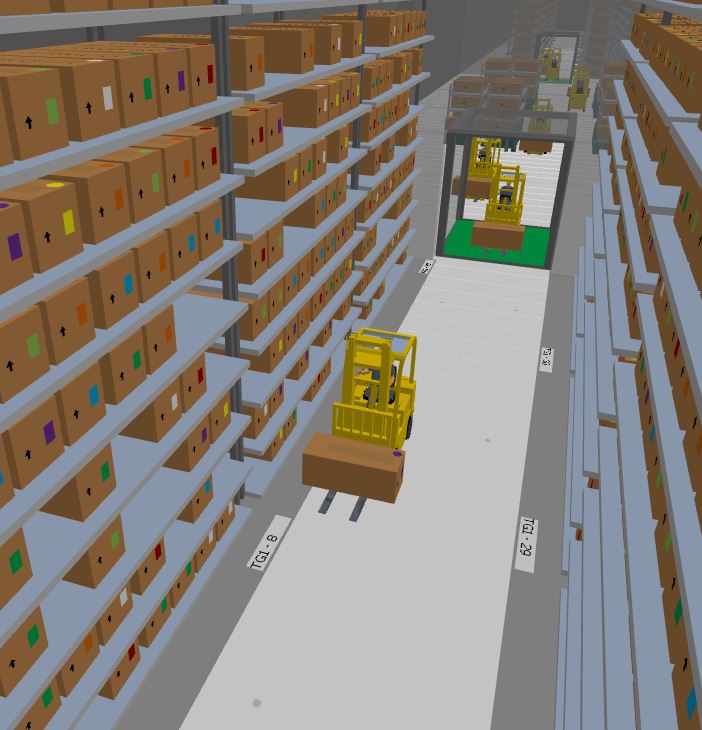
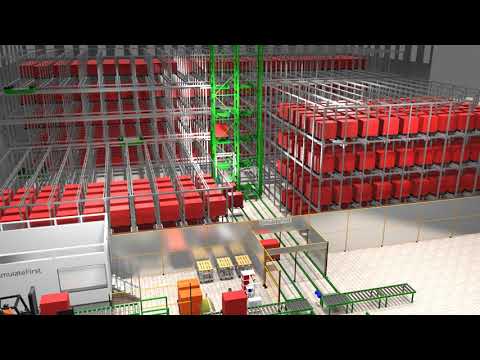
A Simio simulation model replicates your entire warehouse: the physical layout, the AGV route network, the ASRS system, the pick stations, the order logic, and the throughput targets. It then runs thousands of virtual hours of operation, capturing every vehicle interaction, queue, and failure mode.
This lets you test specific fleet configurations — say, 8, 10, and 12 AGVs at two different speeds — and see exactly how each performs against your throughput requirements, before any procurement decision is made.
Data collection & layout import
We work from your warehouse floor plan or CAD layout, AGV network, WMS order data, and ASRS specifications. Where data isn't available, we use validated industry benchmarks and scope assumptions transparently.
Simulation model build
We build the Simio model using the SimulateFirst logistics framework — pre-validated components for AGV navigation, ASRS bay logic, repacking stations, charging cycles, and traffic management.
Scenario testing
We run the configurations you specify — different fleet sizes, speeds, routing algorithms, and demand levels. Each scenario is run with multiple replications to account for variability and produce statistically robust results.
Results & recommendation
You receive a clear report: throughput by scenario, utilisation rates, queue analysis, bottleneck identification, and a specific recommendation for fleet size and configuration. The model is yours to keep.
What you get at the end
Deliverables include: the Simio model file, a scenario comparison report with throughput curves and utilisation rates, a bottleneck analysis, and a written recommendation with the reasoning behind it. If you want to run future scenarios in-house, we offer Simio training as a follow-on.
Simulation vs conventional methods
| Capability | Simio simulation model | Spreadsheet / vendor estimate |
|---|---|---|
| Captures vehicle-to-vehicle interactions | ✓ Full traffic and contention modelling | ✗ Assumes independent operation |
| Accounts for charging cycles | ✓ Modelled per vehicle type and schedule | ✗ Usually omitted or simplified |
| Tests multiple demand scenarios | ✓ Peak, off-peak, seasonal variation | ✗ Single throughput target |
| Identifies specific bottlenecks | ✓ Queue analysis at every node | ✗ Not visible until go-live |
| Statistically robust results | ✓ Multiple replications, confidence intervals | Approximate only |
| ASRS coordination modelled | ✓ Full bay and crane interaction | ✗ Treated as infinite throughput |
What data do we need?
You don't need a perfect dataset to start. We work with what's available and scope assumptions transparently:
- Floor plan or CAD layout — even a rough schematic is enough to start
- Order volume and pick rates — from WMS exports, historical data, or design targets
- AGV specifications — speed, payload, charging time (vendor sheets are fine)
- ASRS parameters — number of bays, crane speed, retrieval cycle time if applicable
- Throughput targets — orders per hour, pallets per shift, SLA requirements
Tools & technology
Our AGV optimization work is built on Simio — the industry-leading discrete-event and agent-based simulation platform, used by logistics engineers and system integrators worldwide. We're a member of the Simio German Group and have built a proprietary AGV framework on top of Simio that dramatically reduces model build time without sacrificing fidelity.
For complex multi-objective routing problems — where you need to optimize AGV scheduling against competing constraints simultaneously — we also use IBM's optimization engine alongside Simio to find provably optimal routing policies.
Mixed fleet — AGVs, AMRs, and forklifts together
When the facility has multiple vehicle types, sizing each one separately is the most common — and most expensive — mistake. An AGV on a fixed route blocks an AMR that needs to reroute. A forklift taking a wide turn at the loading dock creates a recurring queue for AGVs waiting to charge. None of this appears in single-vehicle calculations.
AGV
Follows predefined routes — magnetic tape, QR codes, or wire. The simulation models traffic contention on fixed paths, charging cycles, and intersection priority rules.
AMR
Navigates freely using SLAM — no fixed paths, reroutes around obstacles in real time. The simulation models fleet coordination via the traffic management system and zone reservations.
Forklift
The unpredictable agents in any intralogistics model. Variable speed, unplanned stops, and operator behaviour patterns all affect how much space automated vehicles have. A model without forklifts will overestimate automated throughput.
We model all vehicle types simultaneously in the same Simio environment — each following its own logic, sharing aisles and charging infrastructure. This lets you answer questions like: does switching from 12 AGVs to 8 AMRs maintain throughput? Can the forklift shift pattern change without creating an ASRS queue?
See it in practice
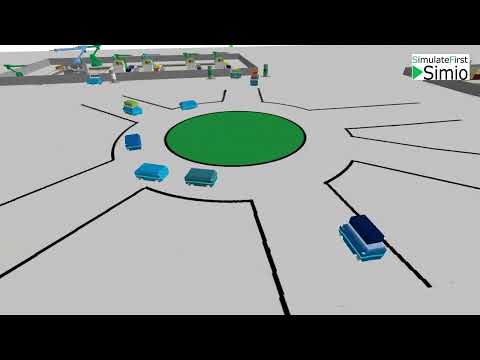
AGV fleet optimisation — fleet size, speed & working hours impact on throughput
Simio · Logistics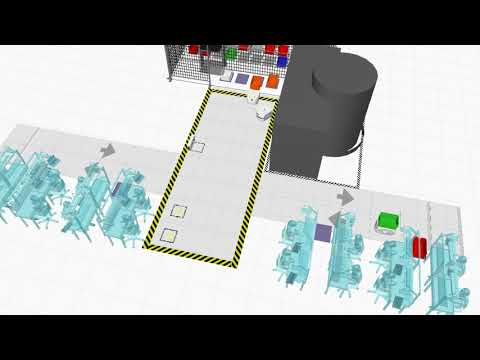
Manufacturing line — AGV coordination with assembly cells
Simio · Manufacturing