Why AGV sizing is harder than it looks
The instinct is to calculate: if you need 500 pallets moved per shift, and each AGV can handle 50, you need 10 vehicles. Add a 20% safety buffer and order 12. Simple.
In practice, that calculation is almost always wrong — usually on the high side, sometimes catastrophically on the low side. The 2024 e-commerce warehouse that ordered 40 AGVs based on peak throughput targets, installed them, and discovered only 28 were ever active at the same time is not an unusual story. Neither is the facility that ordered to the formula, hit a routing bottleneck at three intersections, and had to retrofit additional charging stations and reroute half the traffic.
The fundamental problem: Simple formulas treat AGVs as independent parallel workers. They're not. They share paths, queue at intersections, compete for charging stations, and slow each other down in ways that cascade non-linearly as fleet size grows.
What a spreadsheet model misses
Here's what a formula or spreadsheet cannot capture:
- Traffic conflicts: When two AGVs need the same corridor simultaneously, one waits. That wait cascades. At certain layouts, adding a 15th vehicle makes overall throughput worse because conflicts increase faster than capacity.
- Charging behaviour: AGVs leave the floor to charge. If three vehicles hit low battery at the same shift peak, throughput drops sharply. Optimal charging strategy — opportunity charging vs. scheduled charging — has a larger impact than fleet size in many warehouses.
- Variable trip distances: Picks from a far corner take three times as long as picks from the buffer zone. A fleet sized on average trip time fails when a surge of far picks arrives simultaneously.
- ASRS interaction: If your AGVs feed an automated storage and retrieval system, ASRS retrieval cycle time becomes a throttle. A simulation sized only for AGV throughput ignores this completely.
- Peak demand patterns: Shift starts, end-of-hour pick waves, and manual truck loading windows all create burst demand. A fleet sized for average throughput may fail at 9:00 AM every Monday.
How discrete-event simulation solves it
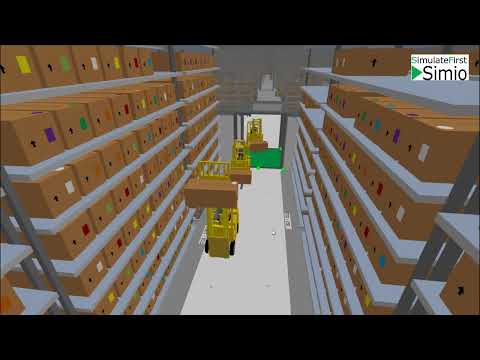
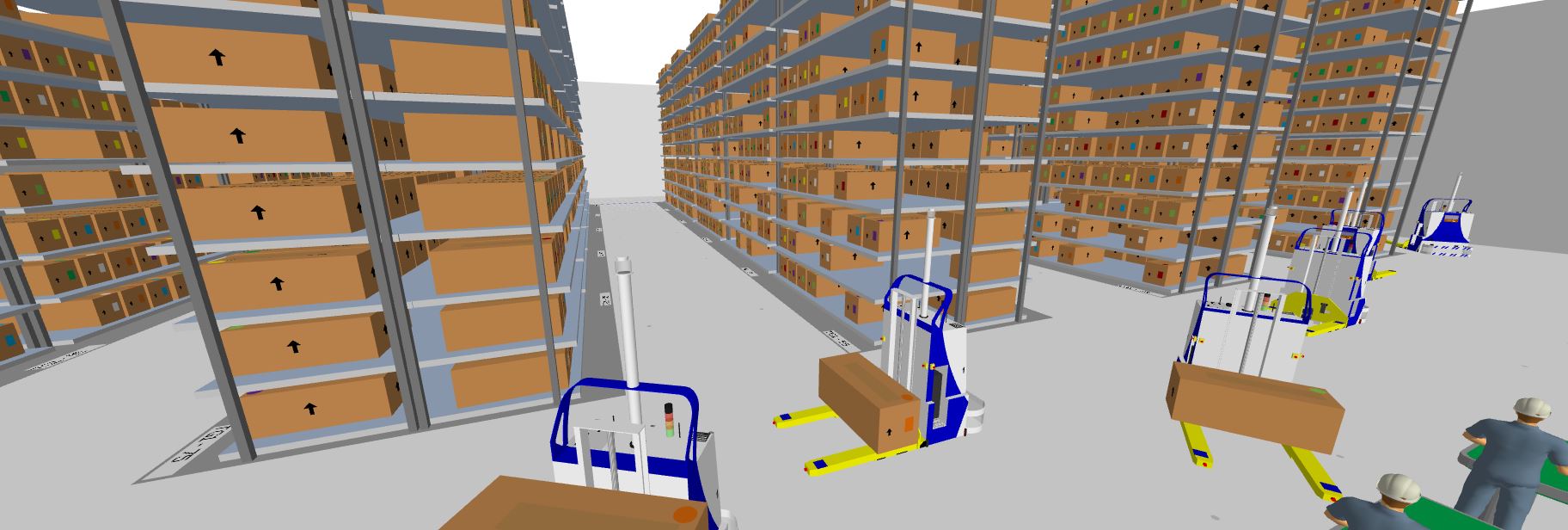
Discrete-event simulation (DES) models each AGV as an individual agent with its own state: loaded or empty, travelling or waiting, charging or ready. It runs thousands of trips simultaneously, resolving conflicts and queues in real time, and generates throughput statistics from the emergent behaviour of the whole fleet.
The result is not a formula output — it's a statistical distribution of throughput across an eight-hour shift, showing average performance, 95th-percentile dips, and the specific conditions that create bottlenecks. You see exactly where the floor fails under peak load before the hardware is installed.
We build AGV simulations in Simio, using the SimulateFirst AGV Framework — a proprietary set of vehicle logic blocks that model battery management, charging strategy, traffic management, and fleet dispatch. For larger optimization problems (optimal number, speed, and route assignment simultaneously), we layer in proprietary optimization logic.
What the simulation model captures
- Full floor layout with all routes, one-way restrictions, and passing zones
- Every pick/drop location with precise travel distances
- Battery model including charge rate, discharge rate by load weight, and opportunity charging rules
- Traffic management logic: priority rules, deadlock prevention, intersection protocols
- ASRS interface if applicable — retrieval cycle times, buffer lane capacity
- Full shift patterns including peak windows, breaks, and throughput ramp-up
- Failure and maintenance: mean time between failures, repair time distributions
Scenarios we test
A typical AGV fleet sizing study runs 100+ configuration scenarios. Common comparisons:
- Fleet size sweep: 8, 10, 12, 14, 16 vehicles — where does marginal throughput per vehicle flatten?
- Vehicle speed trade-off: Fewer faster vehicles vs. more slower vehicles at the same total cost
- Charging strategy: Scheduled charging vs. opportunity charging vs. battery swap
- Routing rule comparison: Shortest path vs. least-conflict routing vs. zone-based assignment
- Layout change: Does adding a passing loop at the main bottleneck intersection change the optimal fleet size?
What you get at the end
Deliverables include: a PDF report with throughput curves for each scenario, the Simio model file, all input data workbooks, and a presentation-ready slide deck for procurement review. The model is built to be re-runnable — if you change a layout assumption or the vendor specifies a different vehicle speed, you can retest without re-engaging us.
Ready to size your AGV fleet with simulation?
We scope AGV fleet studies precisely before any commitment. Most results are delivered within 2–4 weeks of receiving floor plan data.