Production simulation

Find every bottleneck
before you build the line

A discrete-event simulation of your entire manufacturing or logistics process — revealing bottlenecks, quantifying improvement options, and letting you test every what-if scenario safely before committing to any physical change.

15–40%
throughput improvement typically identified through bottleneck analysis
100+
what-if scenarios tested per project on average
1–3 wk
typical project timeline from data collection to results

The problem with improving production without simulation

Every production manager has a list of ideas for improving the line. Add a buffer here. Speed up that machine. Move this station closer. Change the batch size. But which idea will actually help — and by how much? And which will cause an unexpected problem somewhere else?

Without simulation, the only way to find out is to implement the change on a live production line — disrupting operations, committing resources, and hoping for the best. Even experienced engineers are routinely surprised by how complex systems respond to local changes. A throughput gain at one station creates a new bottleneck three stations downstream. A buffer addition increases WIP without improving output.

Production systems are non-linear and interdependent. The only reliable way to predict how a change will behave is to simulate it — where getting it wrong costs nothing.

What production simulation can answer

A SimulateFirst discrete-event simulation model captures your entire process — machines, workers, buffers, conveyors, batching rules, failure rates, and variability — and runs it for thousands of simulated hours. This allows you to answer questions that no spreadsheet can:

  • Where is the real bottleneck — and is it the same one at different demand levels?
  • How much buffer is needed between stations to prevent starvation and blocking?
  • What happens to throughput if the fastest machine fails for 2 hours?
  • How many workers are needed to sustain target throughput across all shifts?
  • Which of three layout alternatives gives the best throughput per unit of floor space?
  • What is the maximum capacity of the current line — and what is the cheapest way to increase it?
1

Data collection & process mapping

We work with your engineers to document the process flow, cycle times, failure rates, batch sizes, worker assignments, and throughput targets. We identify which data is critical and which can be estimated with validated benchmarks.

2

Model build & validation

We build the Simio, AnyLogic, or Visual Components model and validate it against historical production data. A validated model reproduces past performance within a defined tolerance before any scenario analysis begins.

3

Scenario testing

We run the specific scenarios you want to evaluate — plus any our analysis suggests. Each scenario is replicated multiple times to produce statistically robust results with confidence intervals.

4

Results, recommendations & handover

A clear report: throughput by scenario, bottleneck identification, utilisation analysis, and a ranked list of recommended improvements with expected impact. Model handed over for ongoing use.

What you get at the end

Ranked
improvement options with quantified throughput impact per option
Bottleneck
map showing every constraint at current and target demand levels
100+
what-if scenarios tested and compared with statistical rigour

Deliverables: the simulation model file, a scenario comparison report with throughput curves and utilisation data, a bottleneck analysis with visualisation, recommended improvement actions with expected impact, and documentation for ongoing use. The model is yours — no subscription required.

Technology — choosing the right tool

Unlike most simulation providers who specialise in one platform, SimulateFirst is genuinely technology-agnostic. We choose the simulation tool that best fits your problem:

  • Simio — best for manufacturing processes with scheduling requirements, or where digital twin connectivity is a future goal. Native risk-based scheduling output.
  • AnyLogic — best for large-scale logistics networks, processes with complex human behaviour or agent interactions, or multi-method modelling needs.
  • Visual Components — best when accurate 3D CAD representation of the production layout is required, for example to validate reach, cycle time, and spatial constraints alongside throughput.
SimioAnyLogicVisual ComponentsDiscrete-event simulationAgent-based modelling
Related examples

See it in practice

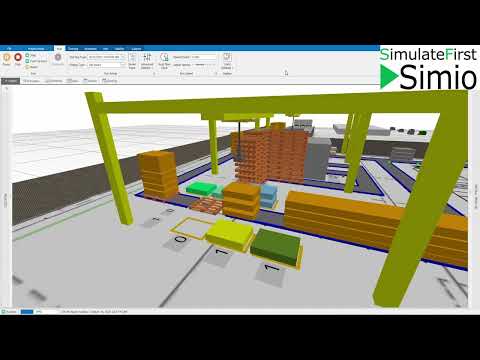
Production and logistics simulation AGV

Warehouse logistics — end-to-end process model with AGV coordination

Simio · Logistics
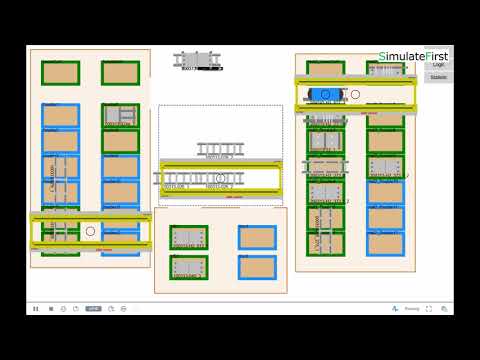
Manufacturing production simulation steel plant

Steel plant — full production process model, ERP integration

AnyLogic · Manufacturing
Production process simulation bottleneck analysis

Multi-line manufacturer — bottleneck analysis across 6 production lines

Simio · Manufacturing
Case study

Large-scale production & logistics model:
complex system optimised before a single change on the floor

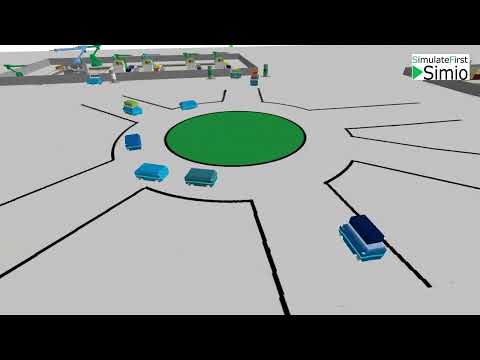
AGV fleet optimisation simulation in Simio
Production & Logistics · Simio

End-to-end production & logistics simulation — full operational scope

A manufacturer needed to understand the true capacity of their integrated production and logistics system before committing to a significant capacity expansion. The system included multiple production stages, an automated warehouse with AGVs, and a complex order mix with variable processing times.

SimulateFirst built a comprehensive Simio model capturing orders, resources, workforce, warehousing, and AGV transport. The model was validated against 6 months of historical output data before scenario analysis began.

True system capacity identified — 18% higher than management estimate
Two critical bottlenecks found — neither was on the original improvement list
Optimal buffer sizes determined for each handoff point
Scenario results presented interactively using Simio dashboard output
View all examples →
AI-assisted modelling

Build production models faster with AI data generation

Production simulation requires accurate input data: cycle time distributions for each workstation, failure rates and repair time estimates, buffer capacities, and shift patterns. Collecting this data from scratch can take as long as building the model itself — and for a new production line that hasn't been commissioned yet, the data simply doesn't exist.

We use AI to bridge this gap. When historical machine logs or ERP data are available, AI processes them automatically — filtering outliers, fitting distributions (Erlang, Weibull, log-normal), and returning Simio-ready parameter tables. When data is sparse or the line is new, AI generates plausible benchmarked estimates based on process category and comparable industry data.

How AI is used in simulation projects →
Cycle time parameterisation
AI fits distributions from MES or ERP export files — no manual Excel work. Outliers filtered, shift patterns extracted, Simio tables ready.
New line concept studies
For production lines not yet built, AI generates benchmarked estimates by process category — viable for feasibility studies and layout comparisons before go-live.
Batch scenario automation
AI writes the Python scripts that run your scenario matrix overnight and export KPI comparison tables — so all 20 configurations are ready for review by morning.
FAQ

Common questions about production simulation

Production simulation models the flow of materials, products, and information through a manufacturing or logistics process. It finds bottlenecks, tests improvement ideas safely, determines optimal resource levels, validates new process designs, and compares layout alternatives — giving you a data-driven answer instead of an educated guess, before any physical change is made.
All three are simulation platforms suited to manufacturing and logistics. Simio excels at discrete-event modelling with scheduling requirements and digital twin connectivity. AnyLogic is most flexible — supporting agent-based, discrete-event and system dynamics modelling in one tool, suited to large-scale logistics or systems with complex human behaviour. Visual Components adds accurate 3D CAD representation, making it the right choice when spatial layout, reach, and cycle time validation matter alongside throughput. We recommend the right tool for each project.
Most projects run 1–3 weeks depending on process complexity. We scope the exact timeline in the proposal phase before any commitment.
Typically: process flow diagram or layout, cycle times per station, failure rates and MTTR, batch sizes and changeover times, workforce scheduling, and throughput targets. Where data is incomplete we use validated benchmarks and scope assumptions transparently. Historical production records are very useful for model validation.
Yes. The 3D animated output from Simio and AnyLogic models is excellent for presenting findings to management — far more compelling than a spreadsheet report. Many clients also use the simulation for onboarding new engineers and production managers, giving them an interactive understanding of how the process works.
Yes — particularly if the model is built in Simio. The step from a validated production simulation to a live digital twin connected to ERP or MES data is a natural evolution. Many clients start with a simulation study and then commission the live integration as a follow-on project once the model is validated and the team is comfortable with simulation as a decision-making tool.
Free consultation

Let's model your production process

Tell us about your manufacturing or logistics process — what you want to optimise, what scenarios matter, and what decisions you need to make. We'll scope the right simulation approach.

Response within 1 business day
Full NDA available as standard
Remote delivery worldwide
Transparent fixed-scope proposal

Germany — Dresden

Anton-Graff-Str. 24, D-01309
dresden@simulatefirst.com
+49 (0) 351 30906020

Poland — Wrocław

ul. Powstańców Śląskich 5, 53-332
polska@simulatefirst.com
+48 75 6406434

We respond within 1 business day · NDA available · No spam, ever

By submitting, your data will be used solely to respond to your enquiry. Privacy policy.