Why spreadsheets fail your supply chain
Supply chain planning software and Excel models work on averages — average demand, average lead time, average yield. But your supply chain fails at the extremes: a Chinese New Year shutdown stretching a 6-week lead time to 14, a demand spike in one region pulling inventory from another, a single-source component disrupting three assembly plants simultaneously.
When planners can only model the average case, they compensate with safety buffers — safety stock, safety lead time, dual sourcing — added at every tier without visibility into how they interact. The result is a network that is simultaneously over-stocked at some nodes and stocked out at others, with no clear picture of which buffer is actually protecting you and which is just costing working capital.
The core insight: Supply chain risk is not linear. A 10-day supplier delay does not cause a 10-day stockout — it can cascade through reorder cycles and cause weeks of downstream shortage. Simulation is the only tool that captures this non-linearity reliably.
What a supply chain simulation actually models
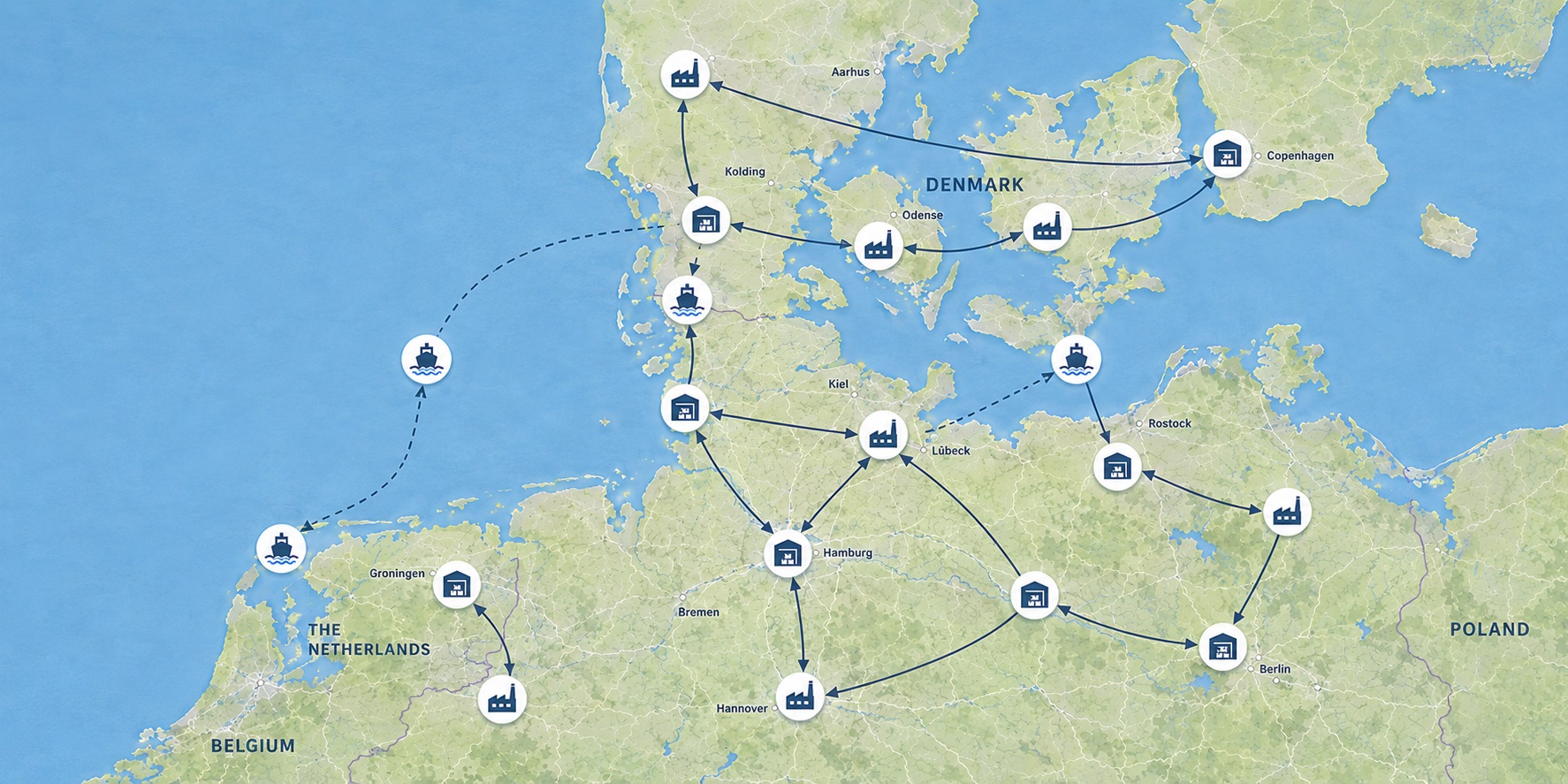
We build a discrete-event or agent-based model of your network that captures every entity — suppliers, plants, DCs, retail nodes — and every flow — orders, shipments, inventory positions, cash. The model runs thousands of replications, each with different demand realisations and disruption events, and produces a distribution of outcomes: fill rate, stock days, transport cost, stockout frequency.
Multi-echelon inventory
Central DC, regional DCs and store-level stock modelled together — finds the right level at each tier without double-buffering.
Network design
Compare 2-DC vs 3-DC vs direct-ship configurations. Model transport cost, lead time and service level simultaneously.
Supplier risk & disruption
Introduce probabilistic disruptions — yield loss, port delays, capacity constraints — and see the true cost of single vs dual sourcing.
Demand variability
Fit real demand distributions per SKU cluster, model promotions, seasonality and new product launches with realistic variability.
Reorder policy optimisation
Test (s,Q), (R,S) and min-max policies across SKU segments — find the combination that minimises working capital at target fill rate.
Mode & lead time trade-off
Air vs sea vs rail — model the inventory cost of long lead times against premium freight costs to find the economic crossover.
How the project runs
Network mapping & data collection
We map all nodes, transport lanes, lead times and current inventory policies. Demand history per SKU is pulled from your ERP. Gaps are filled with structured estimates and sensitivity tested later.
Model build & validation
The simulation model is built in AnyLogic or Simio. We validate it against 12 months of historical actuals — stock positions, order frequencies, fill rates — before running any scenario.
Scenario design & experiments
Together we define the key decisions under study — network redesign options, safety stock levels, supplier strategies. The model runs hundreds of replications per scenario and produces statistically robust output.
Recommendations & handover
You receive a written report with ranked recommendations, confidence intervals and sensitivity analyses. The model is handed over for ongoing use — scenario runner included so your team can test future decisions independently.
What you get at the end
The deliverable is not a slide deck — it is an executable model plus a written decision brief. The model can be re-parameterised as your network evolves, extending the value far beyond the initial engagement.
Simulation vs planning tools — what's the difference?
| Capability | Supply chain simulation | ERP / planning software |
|---|---|---|
| Demand variability | ✓ Full stochastic distributions per SKU | ✗ Average demand only |
| Supplier disruption scenarios | ✓ Probabilistic disruption events modelled | ✗ Not natively supported |
| Multi-echelon interaction | ✓ All tiers modelled simultaneously | Approximate, tier by tier |
| Network redesign comparison | ✓ Any topology, side by side | ✗ Requires manual re-configuration |
| Fill rate confidence intervals | ✓ Statistical output with percentiles | ✗ Single-point output only |
| Reorder policy optimisation | ✓ Policy type and parameters optimised together | Partial — fixed policy structure |
Tools & technology
AnyLogic is the primary platform for end-to-end supply chain simulation — its agent-based and discrete-event hybrid engine handles multi-echelon networks natively. For inventory-focused studies we also use custom Python Monte Carlo models where speed and transparency are priorities. Simio covers production-side integration where the supply chain model connects to a manufacturing simulation.
We have been AnyLogic users since the platform's early industrial release and maintain access to the full Supply Chain Library. All models are version-controlled and documented so your team can maintain them without our ongoing involvement.
Inventory simulation — stock set by variability, not averages
Supply chain modelling answers where inventory should sit across your network. Inventory simulation answers a sharper question: exactly how much? The standard safety stock formula — Z × σd × √L — is elegant and widely used. It assumes demand variability is normally distributed, lead times are independent of demand, stockouts don't affect future demand, and replenishment is instantaneous once the reorder point is reached. None of these assumptions hold in real supply chains.
In practice, demand is lumpy — a few large orders arrive unpredictably between periods of quiet. Lead times cluster around the average most of the time and then occasionally spike — and the spikes correlate with demand peaks, when you most need the stock. Stockouts create backorders that inflate the next order, creating bullwhip effects that a formula cannot see.
The result: Formula-based inventory policies are either over-stocked (because analysts add buffers to compensate for distrust in the formula) or under-stocked when the formula's assumptions break down during demand spikes. Simulation replaces the assumptions with actual distributions fitted to your data.
What inventory simulation answers
Safety stock levels
How much buffer stock is needed to achieve a target service level — 95%, 98%, 99.5% — under your actual demand variability and lead time distribution, not the formula's assumed normal distribution.
Reorder point & quantity
When to trigger a replenishment order and in what quantity — balancing order frequency (transaction cost), holding cost, and the risk of running out between the order and its arrival.
Supplier lead time risk
Which suppliers' lead time variability contributes most to your stock risk — and what additional buffer is required per supplier to maintain your service level target under their specific delivery pattern.
Seasonal & promotional demand
How much to pre-build before a demand surge — seasonal ramp-up, promotional events, new product launches — so that the surge doesn't exhaust safety stock before replenishment can respond.
Monte Carlo vs discrete-event: which approach?
| Approach | Best for | Typical use |
|---|---|---|
| Monte Carlo simulation | Pure inventory policy questions | Safety stock & reorder point when inventory is independent of operational flow |
| Discrete-event (Simio / AnyLogic) | Inventory + operations together | When replenishment interacts with warehouse capacity, receiving dock throughput, or production scheduling |
| System dynamics | Network-level bullwhip & policy | Multi-echelon networks, demand amplification analysis across supply chain tiers |
| Spreadsheet formula | Simple, stable environments | Suitable when demand is genuinely normal and lead times are stable — rare in practice |
What data do we need for an inventory study?
- Demand history — 12–24 months of order or consumption data per SKU, with dates and quantities (ERP or WMS export)
- Lead time records — purchase order history showing order date and goods receipt date per supplier and SKU
- Current inventory policy — existing safety stock levels, reorder points, and order quantities
- Service level targets — your target fill rate or order completion rate by product group
- Cost parameters — holding cost rate and order transaction cost, if a cost optimisation is needed (not required for service level studies only)
- Planned changes — new suppliers, new SKUs, upcoming demand events, or supply chain restructuring plans