Why go-live software bugs are so expensive
When a new production cell or automation system is installed, commissioning begins: engineers connect the control software and run the machine for the first time. In most projects, this is when reality diverges from design — and the bugs appear.
Software errors at this stage are costly in ways that simulation errors are not. Specialist engineers are on-site at day rates. The machine time is on the critical path. Every hour of debugging is an hour of delayed production start. In complex systems, commissioning overruns measured in weeks are routine — and entirely avoidable.
The core insight: PLC code and robot programs can be connected to a simulation model and run against a virtual machine before the physical one exists. Every bug found in simulation takes minutes to fix. The same bug on the factory floor takes days.
What virtual commissioning actually involves
Virtual commissioning is not a simulation of the control logic — it is the real control logic running against a simulated machine. The PLC program, HMI logic, and robot programs are exactly the same code that will run on the real system. The only difference is that the I/O signals are exchanged with a Visual Components 3D model instead of physical hardware.
This means every timing dependency, every sensor trigger, every emergency stop, every interlock condition can be tested — without the physical system being present. The simulation model replicates the mechanical behaviour of the machine with enough fidelity to expose all logic errors in the software.
3D model build
We build a Visual Components model of the machine or cell — kinematics, sensors, actuators, conveyors, and all physical components the PLC needs to communicate with. CAD data from the machine supplier is the starting point.
Control system connection
We connect the model to the real control software using the appropriate protocol: OPC UA for vendor-neutral integration, TwinCAT ADS for Beckhoff systems, Siemens PLC Sim Advanced, or direct hardware-in-the-loop for real PLC hardware.
Systematic test execution
Every sequence, mode, safety condition, and edge case is tested systematically. Bugs are logged, fixed by the software team, and retested — in the same workflow as any software QA cycle, but without any site time.
Validated code for site
The PLC and robot programs that go to site have already been run for hundreds of virtual hours. Physical commissioning becomes alignment, final tuning, and acceptance testing — not debugging.
What you get at the end
Deliverables: the validated Visual Components model, a test protocol documenting every scenario tested and its result, the verified PLC/robot program files, and optional offline programming outputs (robot teaching points generated from the simulation).
Traditional vs virtual commissioning
| Stage | With virtual commissioning | Traditional approach |
|---|---|---|
| Bug discovery | In simulation — days before site | On site — engineers at day rate |
| Fix and retest cycle | Minutes in simulation | Hours or days on site |
| Edge case & fault testing | Systematic in simulation | Often skipped — too risky/costly |
| Physical commissioning duration | 50–70% shorter | Full duration — software + mechanics |
| Risk to machine / product | Zero — all in simulation | Real risk of damage from software errors |
| Deliverable after project | Reusable 3D model + offline programs | No reusable artifact |
Tools & technology
Our virtual commissioning work uses Visual Components — the industry standard for 3D simulation in manufacturing — which SimulateFirst is a certified partner and reseller of. Visual Components has native connectivity for OPC UA, TwinCAT ADS, Siemens PLC Sim Advanced, and supports hardware-in-the-loop via real PLC hardware connected to the simulation.
For robot offline programming, the simulation generates verified robot programs (RAPID, KRL, LS, URScript) that can be uploaded directly to the robot controller — eliminating manual teaching of robot positions on site.
See it in practice
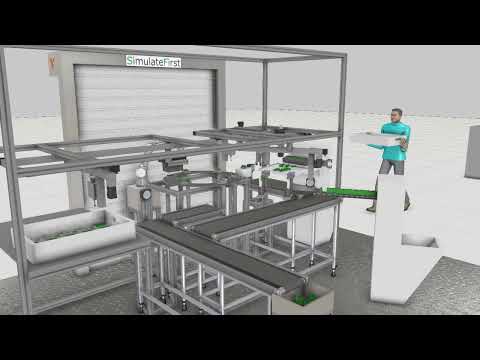
Automotive welding cell — PLC validation before go-live
Visual Components · Automotive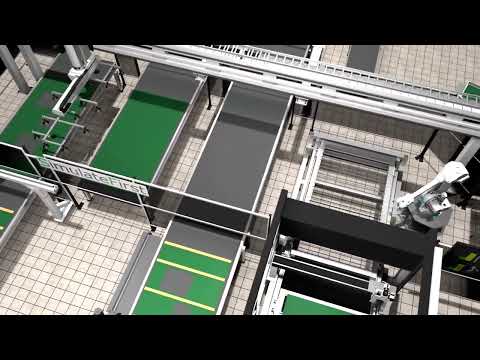
Assembly cell — OPC UA connection to Beckhoff TwinCAT
Visual Components · Manufacturing